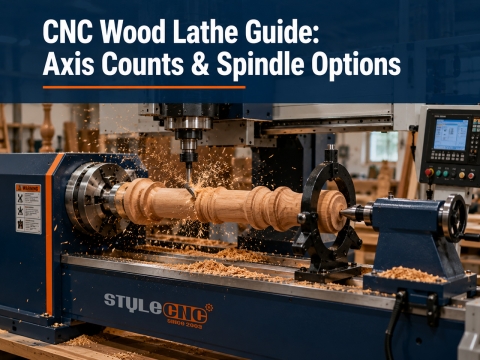
Legs are the application that sells more wood lathes than any other, because they combine everything the machine is good at: repeated identical parts, profiles too slow to hand turn at volume, and a quality standard where one mismatched leg ruins a table. This guide maps leg styles to the machine class that produces them, makes the consistency case in numbers, and covers the blanks, economics, and adjacent parts the same machine unlocks.
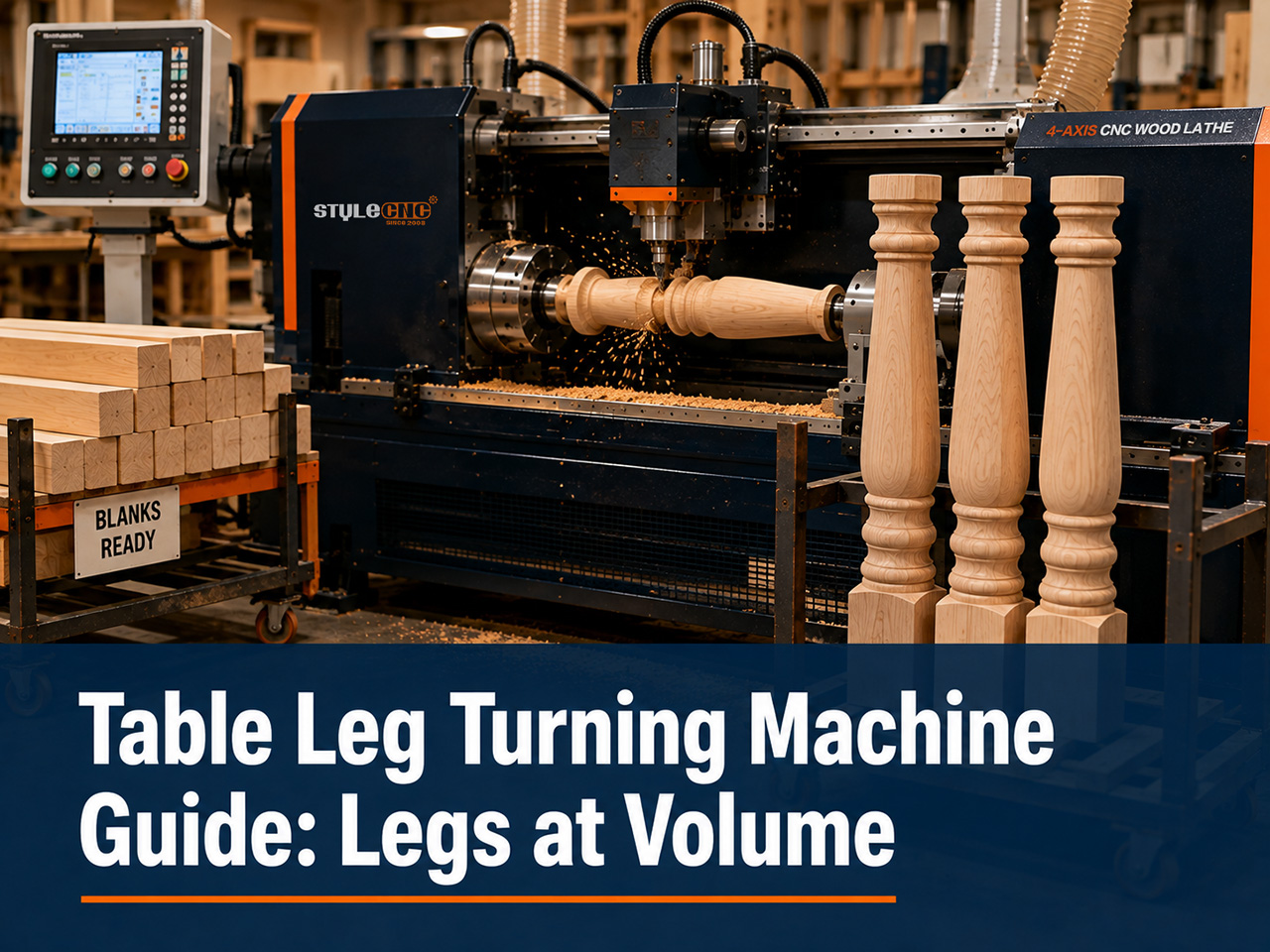
Leg Styles Mapped to Machine Capability
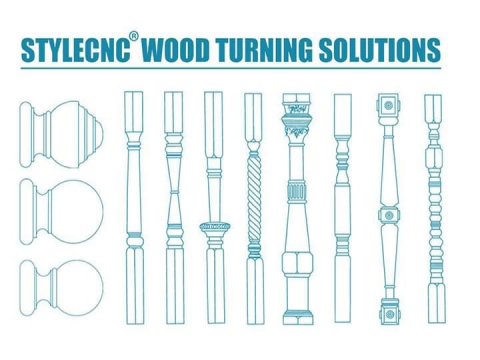
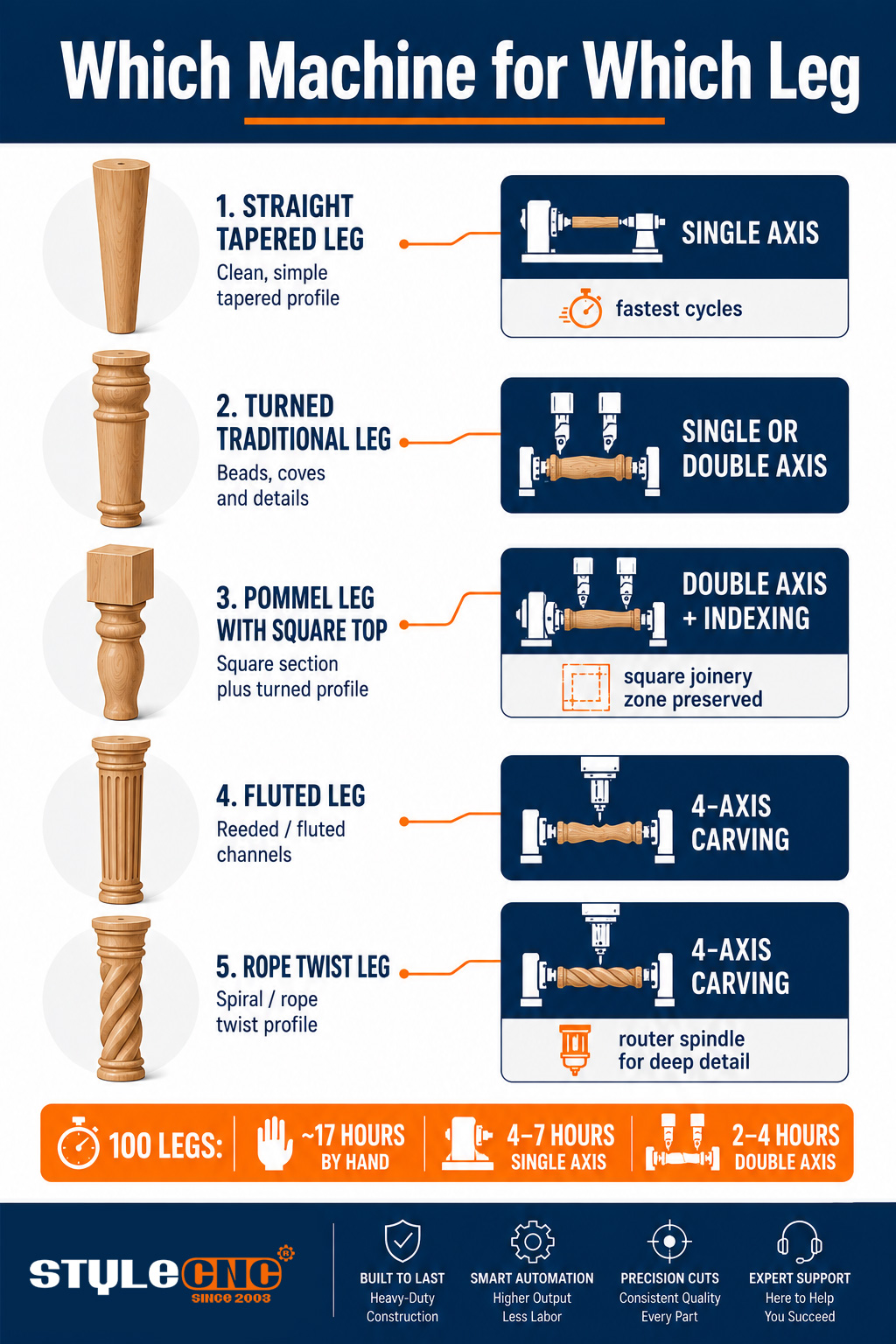
Furniture legs sort into 5 production families, and each family has a minimum machine class that produces it efficiently:
| Stil nogu | Klasa stroja | Cycle Character | Mjerenje |
|---|---|---|---|
| Straight and tapered legs | Single axis automatic | Simple continuous profile, fastest cycles on the machine | Legs per hour at your taper length |
| Turned traditional profiles | Single or double axis | Beads, coves, and vases from one drawn outline | Cycle time on the deepest profile detail |
| Pommel legs, square to round | Double axis with indexing | Square block preserved at the joinery zone, turned below | Transition crispness at the pommel shoulder |
| Fluted and reeded legs | 4-osni s vretenom za rezbarenje | Turning pass plus indexed carving passes in one clamping | Flute count and depth consistency around the leg |
| Rope twist and carved legs | 4-osni s vretenom za rezbarenje | Spiral tool paths along the rotating blank | Twist pitch matching across a 4-leg set |
The mapping runs one direction: a 4-axis machine turns plain tapers happily, but no single axis machine cuts a flute. Buy for the most demanding style your catalog actually sells, not the most demanding style you admire, and the configuration ladder in the vodič za kupnju pravog CNC tokarilice za drvo shows which models sit at each rung.
Batch Consistency: The Case Against Hand Turning
A dining table needs 4 legs that match, and a restaurant order needs forty. Hand turning approaches matching through skill and jigs; the machine achieves it by definition, since every leg runs the same file. The practical tolerance across a CNC batch sits within fractions of a millimeter, tighter than any assembly will ever reveal.
Furniture makers phrase the pain in familiar ways: the 4th leg took as long as the 1st 3 together, or the client noticed the 2 front legs bulge differently in the afternoon light. Those are consistency failures, not speed failures, and consistency is the machine's native advantage. Speed arrives as a bonus: a profile that takes a practiced turner ten minutes runs in 2 to 4 on a single axis machine and roughly half that on a double axis.
Finished leg sets across taper, traditional, and carved styles are easiest to judge in the Galerija projekata CNC tokarskog stroja za tokarenje drva, where matching is visible in a way spec sheets cannot show.
There is a 2nd consistency dividend that only shows up months later: reorders. A client who bought 6 chairs last spring orders 2 more, and the machine reruns the stored file into an indistinguishable pair. Hand work approximates the originals; the file reproduces them, which turns matching replacements from a skilled challenge into routine business.
Blanks and Hardwoods for Leg Work
Leg blanks start as square stock: typically 45 to 80 mm square for dining and side table legs, up to 100 mm and beyond for heavy farmhouse and workbench legs, cut a few centimeters over finished length for the clamping stubs. Straight grain along the full length is not cosmetic preference; grain running out through a slender ankle is where legs break in service.
Beech, maple, birch, oak, and rubberwood dominate production leg turning because they cut cleanly, hold profile detail, and take stain evenly across a set. The same species behavior that governs all primjene u obradi drva u proizvodnji applies at the lathe: dense straight-grained stock rewards the blade, and figured or knotty stock taxes it. Reserve the dramatic grain for tabletops and run the legs in clear stock.
Cycle Economics per Hundred Legs
The purchase math is clearest at batch scale:
• Hand turning at 10 minutes per plain leg: a hundred legs is roughly 17 turner-hours, before a single carved detail.
• Single axis machine at 2 to 4 minutes per leg: the same hundred in 4 to 7 machine-hours with the operator free between loads.
• Double axis: the hundred legs land in 2 to 4 hours, inside a single morning.
• 4-axis carved legs: cycle times stretch with carving density, but the alternative is not slower production, it is declining the order.
Priced against a skilled wage, the hundred-leg batch saves a working day or more every time it runs, which is why leg-heavy shops recover the machine cost within the 1st steady year. The honest caveat runs the other way: a shop that sells ten legs a week is buying idle capacity, and the smaller bands serve it better.
Beyond Legs: What the Same Machine Covers
The machine that turns table legs is not a single-product tool. Stair balusters and newel posts are legs by another name, longer and slimmer but the same between-centers work. Baseball bats are a slender taper with a demanding handle, the application that made double axis support famous. Bed rails, lamp posts, columns, and chair spindles all run from the same drawn-outline workflow.
That breadth matters commercially, because leg orders arrive in waves and the machine earns year-round on the adjacent catalog. A shop quoting furniture legs today and staircase packages next season is running one machine, one workflow, and one operator skill set across both. The bed length bought for newel posts also future-proofs the leg work, which is a quiet argument for sizing capacity one catalog ahead of current orders.
Common Mistakes in Leg Production
• Buying single axis capability for a catalog whose bestsellers are fluted.
• Running figured stock for legs and losing the batch to tear-out at the ankles.
• Skipping the steady rest on slender styles and sanding chatter out of forty legs by hand.
• Cutting blanks to finished length and leaving no clamping stub for the chuck.
• Quoting carved leg work from plain-leg cycle times.
Shortlist Checklist for a Leg Machine
✓ List your 5 bestselling leg styles and mark the most demanding one; that style sets the machine class.
✓ Confirm maximum blank length and square section against your heaviest catalog leg.
✓ Match cycle times to your largest recurring order, not your average week.
✓ Verify pommel and indexing capability if square-top joinery legs are in the catalog.
✓ Price the double axis step against your turner-hours at batch scale.
Često postavljana pitanja
Can one machine make both tapered modern legs and turned traditional legs?
Yes. Both are continuous profiles from a drawn outline, and any single axis production machine runs either. The style change is a file change, which is exactly what makes mixed-catalog shops the natural buyers.
What machine do I need for fluted or rope twist legs?
A 4-axis machine with a carving spindle. The rotary axis indexes or rotates the leg while a router bit cuts the flutes or spiral, work no turning blade can do. Everything below that class produces round profiles only.
How many legs per day can a CNC lathe realistically produce?
A single axis machine at 2 to 4 minutes per plain leg produces 100 to 200 legs across a shift with steady loading; a double axis roughly doubles that. Carved styles scale down with carving density, so quote from your own profiles.
Can it turn pommel legs that stay square at the top for joinery?
Yes, on machines with indexing that hold the square section untouched and turn below the shoulder. Confirm the pommel capability explicitly when quoting, since the crisp square-to-round transition is a spec, not a given.
What blank size do typical dining table legs need?
Most dining legs start from 60 to 80 mm square stock around 750 mm long plus clamping stubs; side tables run smaller, farmhouse and bench legs larger. Let your heaviest catalog leg set the machine's capacity spec.
Will all 4 legs in a set really match?
Within fractions of a millimeter, because each runs the same program on the same blanks. The visible mismatches that survive come from stock variation and stain uptake, which is why matched sets are cut from consistent, clear material.
Can the same machine turn short work like bun feet and sofa legs?
Generally yes, between centers with the stub allowance, though very short fat work is the machine's least comfortable format. If bun feet dominate the catalog, confirm minimum part length and chucking options before buying.
Is a table leg machine different from a baseball bat lathe?
Same machine family, different emphasis. Bats reward the double axis class for slender-handle support, legs reward capacity and indexing options. A double axis production lathe covers both catalogs, which is why many shops run exactly that.
Match Your Leg Catalog to a Configuration
From single axis taper machines to 4-axis carving models, compare the full range of CNC tokarilice za drvo za tokarenje i rezbarenje and get a free quote sized to your leg styles, blank sizes, and batch volumes.